Smart Money Concept in Forex
This educational guide explains how the Smart Money Concept in Forex can help you read institutional intent directly from price action. It is not financial advice. Trading leveraged products like spot FX or CFDs involves significant risk of loss. Regulators in the UK and EU mandate risk warnings and leverage restrictions precisely because many retail accounts lose money.
The FX market remains the world’s largest with 7.5 trillion US dollars in average daily turnover reported in the most recent BIS Triennial Survey. That depth creates nearly endless liquidity and liquidity is the playing field SMC teaches you to read and exploit.
Because this is a YMYL topic, we follow strict quality controls. You will see clear purpose, verifiable facts, conservative claims, and transparent sourcing throughout.
What Does “Smart Money” Mean in Forex?
Smart money refers to institutional capital controlled by banks, non-bank liquidity providers, large hedge funds, and market-making firms. Their order sizes can move price or harvest liquidity around obvious retail levels.
Trading alongside smart money means anticipating their moves. Instead of reacting to indicators, SMC traders track footprints in liquidity, displacement, and order blocks. By understanding this approach, retail traders shift from being victims of stop hunts to positioning themselves in line with institutional intent.
Origins of Smart Money Trading (and ICT’s Role)
Tape readers and floor traders long studied accumulation and distribution cycles. The modern SMC package gained traction through Michael Huddleston, also known as ICT. His teachings on liquidity sweeps, fair value gaps, and breaker blocks spread widely across YouTube and mentorship programs.
ICT did not invent the idea of institutional trading, but he shaped it into a framework retail traders could apply. His influence is why terms like FVG, BOS, and order blocks are now common knowledge in the retail space.
Why Retail Traders Often Lose Without SMC
Most retail traders enter trades at obvious support and resistance levels. They set stops at predictable places such as above equal highs or below equal lows. Institutions often use these stop clusters as liquidity for their own orders.
Indicators further mislead by lagging behind price. While retail traders wait for RSI or MACD to confirm, institutions have already entered and exited. Without SMC, retail traders play checkers while smart money plays chess.
Market Structure and Break of Structure (BOS)
Market structure is the skeleton of price action. It shows whether price is bullish with higher highs and higher lows, bearish with lower highs and lower lows, or consolidating in a range.
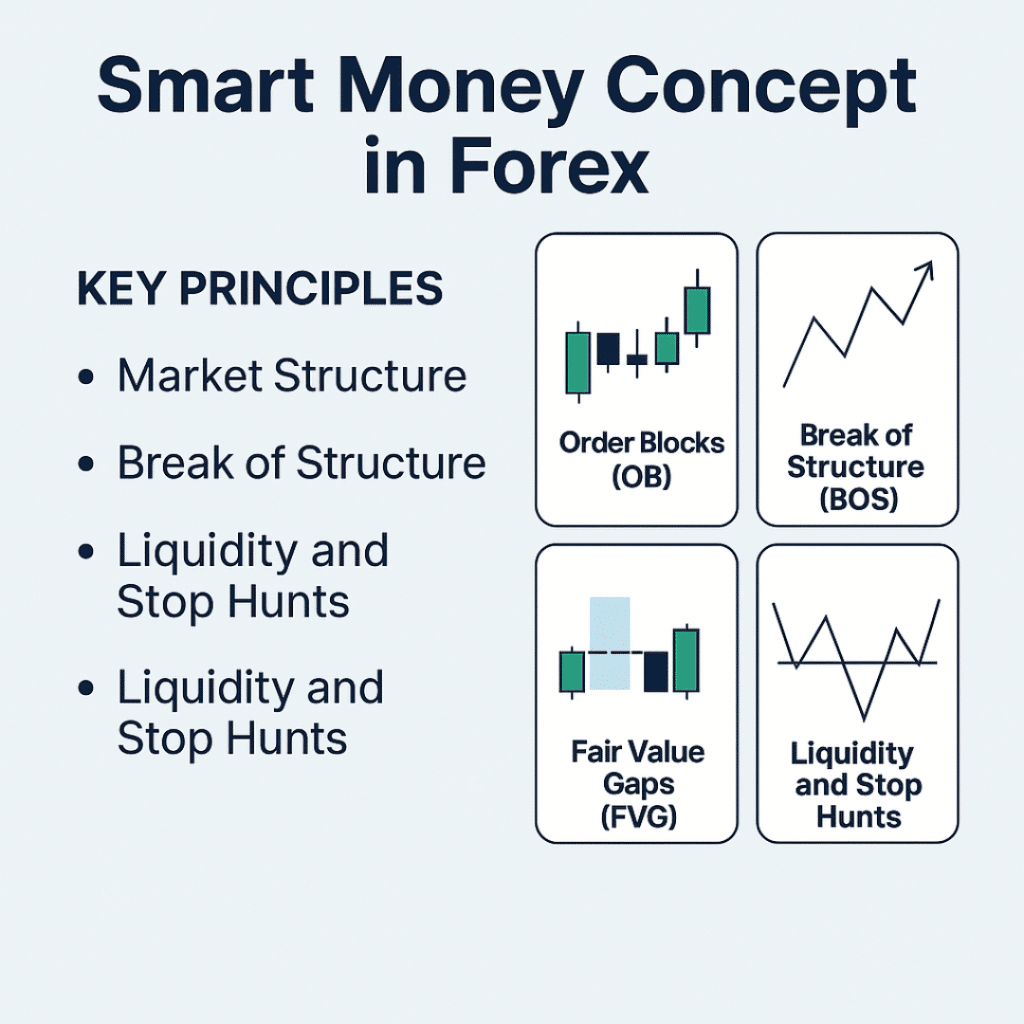
A Break of Structure confirms that market control has shifted. For example, when bullish structure gives way to a new lower low, the bears have stepped in. When combined with displacement and a fair value gap, BOS becomes one of the strongest entry signals.
Change of Character (ChoCH)
Before a BOS, traders often see a Change of Character. This is the first clue that market intent is shifting. On a chart, it looks like a minor structure break against the trend.
Retail traders usually mistake ChoCH for a pullback. SMC traders treat it as a signal to prepare for a possible reversal. ChoCH helps build a conditional plan: if price revisits the origin order block that caused ChoCH, then an entry may be valid.
Liquidity and Stop Hunts
Liquidity is the lifeblood of smart money. Institutions cannot fill huge orders without a counterparty. That is why they often drive price to obvious stop zones.
Equal highs and lows, session extremes, and round numbers are all magnets for liquidity. A sweep followed by a reversal is a classic smart money move. Recognizing these patterns allows SMC traders to avoid being trapped.
Market Phases: Accumulation, Markup, Distribution, Markdown
Accumulation occurs when institutions build positions near lows. Markup follows with a sharp rise as weaker shorts are forced out. Distribution comes next as institutions offload positions near highs. Finally, markdown begins with a sustained decline.
By recognizing these four phases, traders avoid fighting the dominant trend. Instead of buying markdown rallies or selling markup dips, they align their trades with the institutional cycle.
Order Flow and Institutional Intent
Order flow can be read directly from price without order book data. Fast rejections from an order block, explosive displacement that leaves a fair value gap, or consolidation followed by expansion all signal institutional intent.
The goal is not to predict every tick but to follow the narrative of who is in control. SMC traders align their trades with this order flow story.
Order Blocks (OB)
An order block is the last bullish candle before a bearish move or the last bearish candle before a bullish move that created displacement. These are institutional footprints.
Rather than chasing price, SMC traders wait for price to return to the order block. Entries here provide precision and allow stops to be placed just beyond the invalidation point.
Fair Value Gaps (FVG)
A fair value gap forms when price moves so quickly that one side of the order book is left unfilled. These three-candle imbalances act like magnets, pulling price back to fill them.
FVGs are stronger when they align with a break of structure or sit within an order block. When combined with session timing such as London or New York open, they offer high-probability trade setups.
Mitigation Blocks
A mitigation block occurs when price revisits a prior order block to fill unfilled orders. Once mitigated, price usually continues in the same direction without hesitation.
Traders use mitigation as both confirmation and risk management. If price closes through the block, the trade idea is invalid.
Balanced Price Ranges
A balanced price range is an area where buyers and sellers agreed on value. Price often consolidates here before breaking out.
When price later revisits a balanced range, the reaction shows who is now in control. Acceptance suggests a return to range, while rejection signals trend continuation.
Kill Zones (Optimal Trading Times)
The best opportunities do not appear at all hours. SMC highlights London Open, New York Open, and London Close as kill zones.
These sessions see the highest volatility and manipulation. By focusing on these times, traders align with institutional activity rather than random price action.
How SMC Compares to Other Theories
Smart Money Concepts and the Wyckoff Method share a common foundation in identifying accumulation and distribution phases. Wyckoff relies heavily on schematics and is more historical in nature. SMC, however, is built for real-time execution. It uses clear triggers like BOS, ChoCH, and FVG to give actionable entries.
When compared to indicator-based retail trading, SMC provides a deeper look at why price behaves as it does. Indicators such as RSI or MACD summarize past movement, while SMC asks why a support level failed or why a breakout reversed. This focus on intent rather than reaction is what gives SMC an edge.
ICT and the Rise of SMC
Michael Huddleston, better known as ICT, played a central role in popularizing Smart Money Concepts. His hours of free educational material introduced liquidity sweeps, order blocks, and fair value gaps to tens of thousands of traders.
Popular setups in the ICT playbook include the Judas Swing, which traps retail traders during the London Open, and Breaker Block entries that come after a BOS and mitigation. Another favorite among advanced SMC traders is the FVG and Order Block combination, which provides sniper-level precision.
How to Trade Using Smart Money Concepts (Step-by-Step)
The first step is to identify market structure. Determine whether the market is bullish, bearish, or ranging. Draw swing highs and lows and mark breaks of structure and changes of character. This gives you a narrative framework.
Next, locate liquidity pools. These are most commonly found above equal highs, below equal lows, or at session extremes. Institutions target these areas for entries because retail stops provide the liquidity they need.
Once liquidity zones are mapped, look for high-probability entries. The best setups usually involve a confluence of an order block, a fair value gap, and a BOS, all occurring during a kill zone session.
Risk management is key. Instead of arbitrary stop-loss placement, use institutional invalidation points such as the candle that created the order block. If price trades through that level, your setup is wrong and you exit.
Advanced SMC Tips for Consistent Profits
Volume Profile can add extra confluence to Smart Money Concepts. When a fair value gap or order block aligns with a low-volume node or sits just beyond the point of control, the probability of a strong move increases.
Sessions also play a strategic role. The Asian session often sets the day’s range. London typically engineers a false move or liquidity raid, while New York provides the true expansion or continuation. By trading the sessions as a narrative, you avoid being shaken out by random volatility.
The right tools help as well. TradingView is excellent for marking order blocks and fair value gaps. Some traders use Bookmap or other order flow tools for confirmation. Journaling platforms such as Notion or Edgewonk ensure you track every setup and outcome.
Compliance, Risk and Real-World Context
The FX market processes more than seven trillion dollars daily. That depth creates the liquidity institutions thrive on, but it also creates traps for retail traders. Regulators like the FCA in the UK report that around 80 percent of retail CFD traders lose money.
To protect traders, the European Securities and Markets Authority enforces leverage caps, negative balance protection, and mandatory risk warnings. These rules are designed to stop traders from blowing accounts in a few trades.
Smart Money Concepts provide an edge only if combined with strong risk management. Without discipline, even the most accurate setups will not save a trader from over-leverage.
Common Pitfalls and Fixes
Many traders overfit strategies to a few historical examples. They see one pattern play out and assume it is a universal law. The solution is forward testing across at least 20 to 30 trades.
Another pitfall is hindsight bias. It is easy to draw order blocks and fair value gaps after price has moved. The fix is to pre-mark levels and conditions before the session begins.
Some traders also fail to factor in timing. A perfect level entered at the wrong session can fail. Marrying location with session timing dramatically improves win rates.
Finally, revenge trading destroys accounts. If a trade fails, many retail traders rush back in to make back the loss. The best solution is to set a daily stop limit and walk away when it is hit.
Backtesting, Journaling and Iteration
Journaling is the difference between guessing and improving. Create tags for setups such as BOS displacement, OB-FVG overlap, London raid, or New York continuation. Record screenshots before and after every trade.
Each week, review your hit rate, average risk-to-reward, and whether trades performed better in certain sessions. Also review rule breaks and find ways to prevent them. Your journal becomes a mirror that exposes both strengths and weaknesses.
Smart Money Concept in Forex: Practical Example
On the daily chart, imagine a bearish bias after a BOS broke below the last higher low. Weekly structure also shows room for price to fall into prior demand.
Liquidity sits above yesterday’s London high and below the Asian range lows. During London Open, price sweeps the London high, triggering retail buy stops. Immediately after, a lower-timeframe ChoCH forms and M5 prints a BOS back down.
Entry is placed on the return to the bearish order block that overlapped with an H1 fair value gap. Stops are placed above the wick that raided liquidity. Targets include the fair value gap fill, the Asian low, and finally the prior daily demand zone.
Conclusion: Is SMC Right for You?
The Smart Money Concept in Forex is not a magic bullet. It is a framework for understanding institutional intent. Traders who enjoy building narratives and analyzing structure will find it rewarding. Those who prefer plug-and-play indicators may find it overwhelming at first.
The best way to learn is to practice on a demo account. Start with one setup, forward test it at least 30 times, and review the results. Over time, you will discover whether SMC fits your trading style.
FAQ’s
Yes—if applied correctly. Like any method, success depends on discipline, backtesting, and execution. SMC gives an edge, not a guarantee.
Absolutely, but expect a learning curve. SMC is like chess—not checkers. Start with demo trading.
Different styles. ICT is actionable and modern. Wyckoff is classic and conceptual. Why not learn both?
ICT’s YouTube, mentorship programs, and communities like Twitter FinTwit or ForexFactory have great discussions.
About the Author

Ian Cabral is the co-founder and Chief Operating Officer of SecretsToTrading101.
With a background in computer engineering and over 10 years of experience in forex trading, Ian helps lead the technical and operational side of the business. His work focuses on trading tools, automated systems, platform processes and educational resources that help traders better understand market structure, trading conditions and risk.
Ian supports the development of practical trading resources designed to make complex trading concepts easier to understand. He also helps ensure that SecretsToTrading101’s tools and education remain clear, structured and aligned with real trading challenges.