What Are Prop Trading Firms?
Proprietary trading firms, or “prop firms,” offer traders access to significant amounts of capital in exchange for a cut of the profits. They’re kind of like angel investors for day traders—funding your skills without demanding your house deed.
Imagine a coach betting on your sprinting skills. If you run well, you both win. If not? You’re benched without losing your own money. That’s essentially how prop firms work.
How Prop Firms Work
At their core, prop firms evaluate your trading ability via challenges or evaluation phases. Pass their test (typically a demo account phase) and you get access to real money. Lose too much? You’re out.
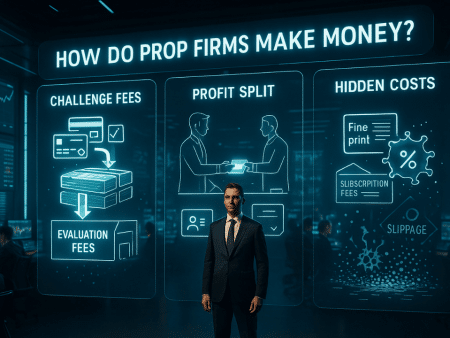
They make money from:
- Evaluation fees
- A portion of trader profits (usually 10–50%)
- In some shady cases, repeatedly failing traders to milk fees
Models vary. Some firms operate like real funding partners. Others? Not much better than a rigged claw machine at a fair.
Prop Firms vs Traditional Brokers
Prop Firms
- Provide capital
- Funded after evaluations
- Revenue from profit shares and fees
- No direct risk to trader’s capital
Traditional Brokers
- Facilitate trades using your money
- Revenue from spreads, commissions
- Must be licensed and follow strict KYC/AML rules
Here’s the rub: traditional brokers are regulated to the teeth. Prop firms often operate in regulatory gray zones—especially in forex and CFDs.
Why Are Prop Firms Being Banned in the US?
US Financial Regulations and Oversight (CFTC, SEC, NFA)
The U.S. treats financial markets like a nuclear power plant: high risk, high reward, massive regulation. Agencies like the CFTC, SEC, and NFA are in charge of keeping traders (and their money) safe.
These regulators argue many prop firms:
- Aren’t properly registered
- Market to retail traders without disclosure
- Use platforms (like MetaTrader) that bypass key controls
In short, they’re operating like brokers without broker licenses—an illegal offense under U.S. law.
MetaQuotes and MetaTrader Platform Restrictions
Many prop firms rely on MetaTrader 4 (MT4) and MetaTrader 5 (MT5). But after pressure from U.S. regulators, MetaQuotes pulled MT4/5 from Apple’s App Store in 2022. Why?
The platforms were allegedly being misused by scam brokers and unregulated prop firms. Their removal sent shockwaves through the industry and signaled to traders: the feds are watching.
Legal Pressures on FX and CFD Prop Trading Models
Forex and CFD prop firms often offer high leverage and simulate trading environments that mimic real markets—but they’re not actually executing real trades.
That distinction matters.
To U.S. regulators, it smells like a synthetic casino:
- Traders think they’re trading real markets
- But trades never hit the interbank market
- Profits come from evaluation fees—not market performance
That’s a violation of transparency and potentially fraud under SEC and CFTC rules.
Enforcement Trends and Compliance Risks
Crackdowns started softly—removal of apps, warning letters. Then came the legal actions:
- Fines issued to firms offering unregistered securities
- Firms blocked from onboarding U.S. clients
- Threats of jail time for persistent violators
The message is clear: if you’re offering trading capital without proper licensing, you’re next.
How the US Ban Impacts Traders
The US ban on prop firms has ripple effects across all trading communities.
Effects on Forex Traders
Forex prop firms are hit hardest. Many shut down U.S. operations overnight, leaving funded traders scrambling. Others pivoted to offshore registrations—often with shady oversight.
The result? Fewer reputable options, more scams in disguise.
Stock Traders and Access to Capital
Equity-focused traders also feel the sting. Legitimate prop shops like SMB Capital and T3 Live remain, but they require:
- Series 7 licenses
- Physical presence or remote verification
- Real brokerage registration
No more plug-and-play funding for hobbyist day traders.
Differences for US vs Non-US Clients
Non-U.S. clients can still access many prop firms—at least for now.
U.S. clients, however, face:
- Geolocation bans
- Declined KYC verifications
- Reversed payouts
Even VPNs aren’t foolproof. If your ID says “Texas,” you’re out of luck.
What Are the Alternatives for US Traders?
All hope isn’t lost. U.S. traders have workarounds, though they come with risks.
Offshore Prop Firms & Regulatory Risks
Some firms now base themselves in Dubai, Cyprus, or Caribbean havens. These offer funding to U.S. clients but come with no FDIC safety net, no SEC oversight, and little legal recourse.
Trade with them? Sure. Trust them? That’s another question.
Futures & Stock-Focused Prop Firms
Futures-focused prop firms like Topstep remain operational in the U.S. because:
- They trade regulated CME products
- They comply with U.S. futures laws
- They avoid forex/CFD territory
These are safer, though not always beginner-friendly.
Independent Trading & Funded Accounts
Self-funded trading remains king.
If you’ve got:
- A solid strategy
- Proper risk management
- $5,000+ in savings
…You might skip the prop firm circus entirely.
Alternatively, build up with simulated trading competitions like those run by TradeNet, OneUp Trader, or Earn2Trade.
The Future of Prop Trading in the United States
It’s not all doom and gloom. The US ban on prop firms might just be the nudge the industry needed to clean up its act.
Regulatory Innovation and Legal Loopholes
New models are emerging:
- Fintech firms offering capital via investment platforms
- Hybrid education/funding programs registered as academies
- Digital licenses mimicking Series 7 requirements
In other words, the game is evolving.
Rise of Transparent, Compliant Prop Firms
Firms are realizing transparency = longevity. Expect to see:
- Public audits
- Real-time trade execution
- Licensed partnerships with clearing firms
These aren’t just pipe dreams—they’re becoming industry norms.
How Platforms and Brokers Are Evolving
With MetaTrader under scrutiny, platforms like cTrader, NinjaTrader, and TradeStation are stepping up. They offer:
- Direct broker integrations
- Greater data security
- Compliance-friendly structures
Tech always adapts faster than policy.
Final Thoughts: Is This the End or Just the Beginning?
The US ban on prop firms isn’t about crushing traders. It’s about protecting them from predatory models.
Sure, the wild west days may be over. But the next era? It could be better—more transparent, more profitable, and more legitimate.
As the dust settles, remember: regulation isn’t the enemy of innovation. It’s the bedrock of trust.
FAQ
Only a few allow U.S. clients, often via offshore loopholes. However, these carry higher risks.
It was removed due to concerns about misuse by unregulated firms. Some firms now use alternative platforms.
No, but many use aggressive marketing and lack transparency. Look for firms with real registration and legal structure.
Not inherently, but funding from unregistered entities may breach SEC/CFTC guidelines.
About the Author

Ian Cabral is the co-founder and Chief Operating Officer of SecretsToTrading101.
With a background in computer engineering and over 10 years of experience in forex trading, Ian helps lead the technical and operational side of the business. His work focuses on trading tools, automated systems, platform processes and educational resources that help traders better understand market structure, trading conditions and risk.
Ian supports the development of practical trading resources designed to make complex trading concepts easier to understand. He also helps ensure that SecretsToTrading101’s tools and education remain clear, structured and aligned with real trading challenges.